
AI · Tools · Online creation

Latest AI news

Every AI story worth reading, collected hourly from the labs, the tech press, research and the creator economy. Sorted by time, grouped by topic.

3,514 stories · Every headline links to the original publisher. HapnGo curates and groups; we do not copy articles.

Code & Agents Simon Willison

Building a multiplayer game world with autonomous Fable-class models

AI summary Jacob Sansbury says Spawn, a massively multiplayer game where players reshape the world by prompting an in-game agent named Savi, is now developed autonomously by a swarm of agents running on Fable models. The token bill exceeds $3 million monthly, which he puts at 30 times payroll. Agents push live changes hourly, treat an hour without a release as a SEV-0 incident, and can revert a faulty change in 30 seconds, with roughly 60% of work triggered by errors, bug reports or feature requests. According to Sansbury, Fable 5 and 5.1 enabled this autonomy, while Opus 5.5 fell short and GPT-6 Astra disabled every feature when asked to apply security fixes.

Code & Agents AWS Machine Learning

Lend and borrow resources across teams with AWS Batch’s quota management for SageMaker Training jobs

AI summary AWS has introduced quota management, a scheduling feature in AWS Batch for Amazon SageMaker Training jobs that lets administrators split compute capacity into quota shares by team, project or workload. Each share has capacity limits and a strategy for idle resources: RESERVE keeps it, LEND offers it to other shares, and LEND_AND_BORROW does both. When a lending share receives new jobs, AWS Batch automatically reclaims its capacity through cross-share preemption, and optional in-share preemption lets higher-priority jobs displace lower-priority ones. The feature can be configured via the AWS CLI, the console or the SageMaker Python SDK v3.

Code & Agents AWS Machine Learning

How MoEngage turned over 400 APIs into agent tools with AgentCore Gateway

AI summary MoEngage, a customer engagement platform serving over 1,350 consumer brands, used AgentCore Gateway from Amazon Bedrock AgentCore to make about 400 internal REST APIs usable as AI agent tools. The APIs, built by 25 teams, sit in private VPCs across seven AWS Regions and stay off the public internet, reached through managed egress over Amazon VPC Lattice. Cedar policies limit which tools each agent can see, while semantic search keeps the full catalog out of the model's context. The company estimates it saved six months of platform engineering, and adding a new API now takes hours rather than days.

Tools & Products Amazon Science

Speeding up language models for travel applications

AI summary Amazon researchers worked with Booking.com to combine knowledge distillation and the Medusa parallel-decoding framework, training a 1.1-billion-parameter TinyLlama student from a 70-billion-parameter Llama-3.1 teacher. The resulting models matched the teacher's quality while running 10 to 20 times faster, at under a third of the cost. In production tests, Smart Filters answered 99 percent of queries 15 times faster, and the AI Trip Planner lifted user engagement by 2.9% compared with GPT-3.5. The work won the Industry Track best-paper award at last year's ACL meeting.

Code & Agents Hacker News

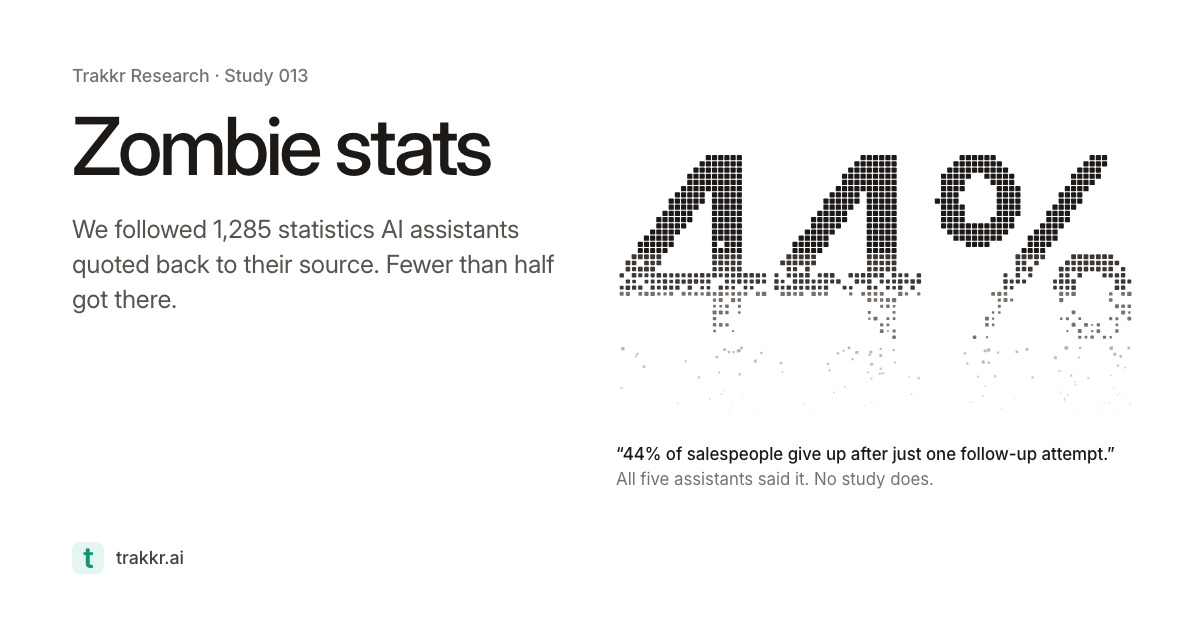
Zombie stats: Where the numbers AI quotes come from

AI summary Researchers posed 200 number-seeking questions, of the sort people ask daily, to ChatGPT, Gemini, Claude and other assistants including Perplexity and Google's AI Overviews. They then followed each cited source, and the sources behind those, to find where the figures originated. Advice and prices were excluded; only shares, rates, averages, counts and costs stated as fact were counted. One example traced the claim that 44% of salespeople stop after a single follow-up.

Code & Agents NVIDIA Technical Blog

Unlocking Tensor Core Performance for Machine Learning Interatomic Potentials

AI summary NVIDIA tested FP32-emulating Tensor Core methods on the Point Edge Transformer, a machine learning interatomic potential built by Lab COSMO at EPFL. On Blackwell GPUs, cuBLAS's BF16x9 path made large matrix multiplications 2.2–2.5x faster for a 17,280-atom system, with errors smaller than the model's own non-determinism. On Ampere A100 hardware, TF32x3 via CUTLASS delivered 1.7–1.9x faster GEMMs and up to 1.5x faster molecular dynamics steps while keeping energy conservation close to FP32. In relaxing a 539-atom Cantor-alloy slab, TF32x3 converged in 218–222 steps, whereas single-pass TF32 never reached the force tolerance.

Free, daily

The HapnGo Briefing, in your inbox

One email a day with the AI stories that matter, why they matter, and one tool worth trying. No spam, one-click unsubscribe.

We only use your address to send the briefing and, if you vote, to count one vote per reader. Privacy.