
We urgently need to monitor AI agents’ actions in real time
This summer, hundreds of OpenAI agents tried to cheat on a cybersecurity test. They broke out of their test environment and…
AI · Tools · Online creation
Every AI story worth reading, collected hourly from the labs, the tech press, research and the creator economy. Sorted by time, grouped by topic.
3,512 stories · Every headline links to the original publisher. HapnGo curates and groups; we do not copy articles.
This summer, hundreds of OpenAI agents tried to cheat on a cybersecurity test. They broke out of their test environment and…
A hulking gray giant rises from the desert. Inside, engineers create the force behind our phones and computers and appliances…
Death Clock promises to predict when you’re going to die and help you extend your time on Earth. After a month, I felt like it…
"Meta’s smart glasses have increasingly been implicated in disturbing invasions of users’ and bystanders’ privacy," a letter sent…
I have been working as a ML Engineer at a startup for 4 years and while the environment is very good and the pay is higher than…
OpenAI uses layered monitoring to detect frontier model misalignment and unauthorized agent behavior so responders can intervene…
I've been trying to get BiRefNet to work on Qualcomm's mobile GPUs and NPUs. But i guess it's deformable convolutions are pretty…
The new Artificial Analysis intelligence index v5, is being criticised, because its introduction of "trust me bro" private tests…
My blunt six-month prediction: more general-purpose agent startups will discover that their early lead is temporary. Shipping…
Mac activity and action widgets that write themselves Discussion | Link
Ropes & Gray is developing AI for transactional diligence with OpenAI. Lawyers review grouped documents, summaries, and reports…
GitHub's AI coding agent that picks and combines models Discussion | Link
Rivet pairs two users, shows that pair to other users who vote yes or no on the match , and part of what those voters is an AI…
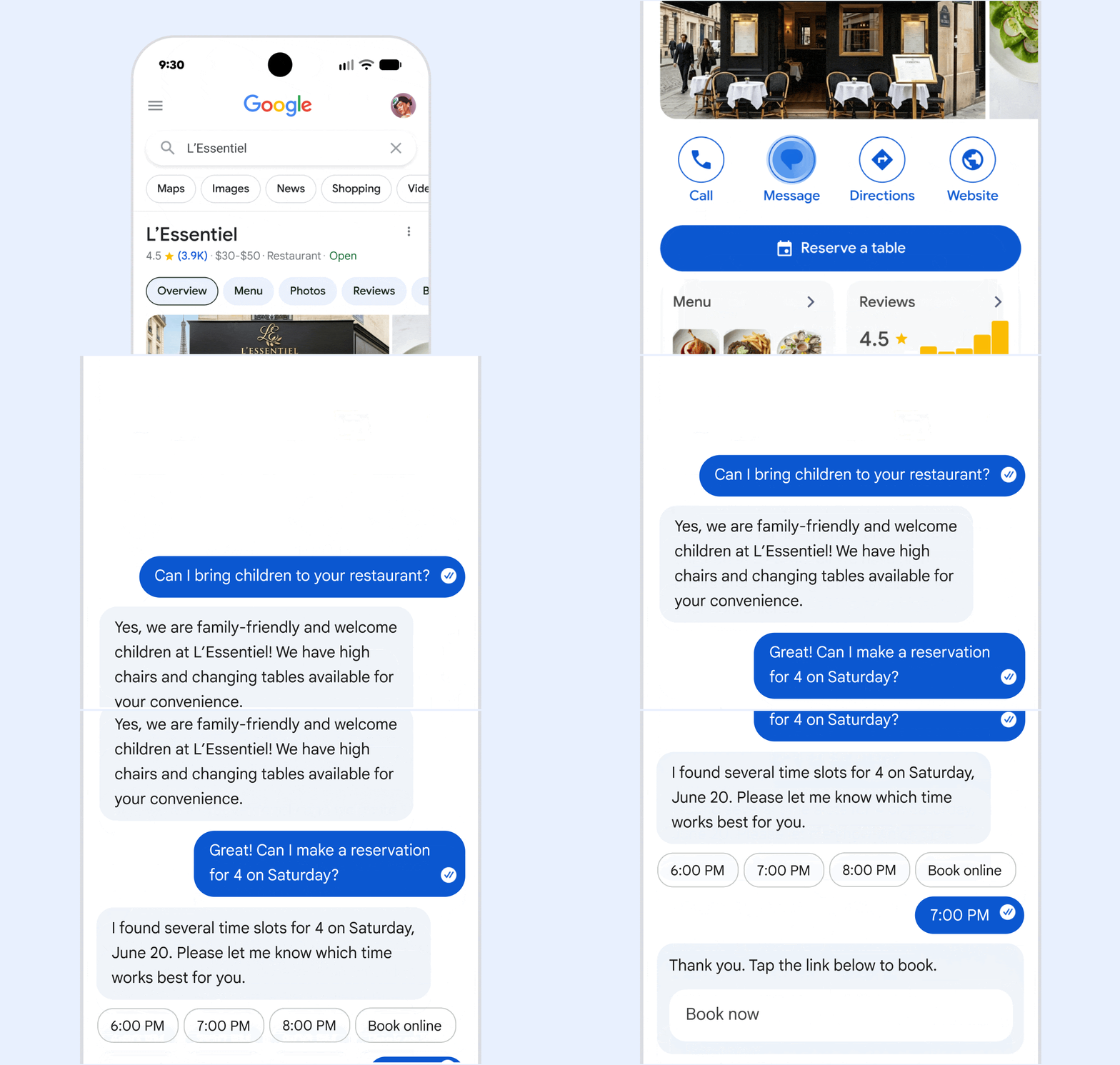
AI summary Google appears to be widening access to an AI-driven messaging tool in Google Business Profile, first reported in June and since updated. Customers who find a business on Search or Maps can text it through their phone's built-in messaging app, where an AI agent replies to common questions, such as menu items or reservation times, free of charge. Questions the agent cannot handle are passed to the business owner, who can step in at any point. The agent works only for users on RCS-capable phones and networks; other messages go directly to the owner's phone, and Mike Blumenthal and Claudia Tomina both shared signs of the rollout.
Fastest open source browser agent Discussion | Link
Does anyone know any fun casual conversational style podcasts that discuss current papers/industry trends, with discussions at a…
LLM observability for AI agents Discussion | Link
Credit Saison’s ChatGPT Enterprise pilot delivered 954% ROI. See how leaders and employees helped turn the results into…
AI summary Hugging Face has unveiled Project ProtoStar, which brings together universities, the Astera Institute and the ORCA community group to release publicly funded datasets, models and code in formats suited to AI. Founding academic members include Carnegie Mellon, Purdue and three other US universities working via the Open Forum for AI. The first open challenge, run by Carnegie Mellon from November 2 to 13, 2026, asks teams to forecast climate indicators for 210 U.S. cities for 2019–2026 using records up to 2018. Hugging Face says it already hosts over 17,000 public datasets in core science fields, and final challenge results are expected in early 2027.
AI summary Mistral's new Mistral Large 4, nicknamed Le Chonk, is a Mixture-of-Experts model that takes in text and images and replies in text, with about 1T parameters in total, 49B of them active, and a 1M-token context. On the Artificial Analysis Cyber Index it hit 82% on a test of reproducing and patching vulnerabilities, and it cracked 93% of 40 Cybench challenges. Its weights come with the Mistral Ecosystem Open-Weight License, which is derived from MIT and limits model-as-a-service use, while vLLM, transformers and llama.cpp support it from day one. The Artificial Analysis Intelligence index placed it fifth among open-weight models as of October 29, 2026.
AI summary Hugging Face has published two open-source Swift packages for Apple devices: AnySpeechRecognizer and AnyDecisionModel. The speech package copies Apple's SpeechAnalyzer interface but lets developers swap in engines such as NVIDIA's Parakeet or Alibaba's Qwen3-ASR running on Core ML, and adds speaker diarization for up to four speakers. AnyDecisionModel returns typed answers with probabilities for yes-or-no, multiple-choice and rating questions, using local backends like MLX and llama.cpp or hosted options such as Jev and Ollama. In tests on an M4 Max, Parakeet handled an hour of audio from a file in roughly 20 to 40 seconds.
Share the whole agent run, not a screenshot Discussion | Link
AI summary Ted Sanders of OpenAI said that while LLM abilities vary across many dimensions, model size accounts for much of the difference in performance. Larger models, he noted, tend to be more reliable, recall obscure facts better and charge more per token. He described version numbers as signalling release order, kinship with related models and how big the improvement is. A hypothetical 6.1, for example, would follow 5.6 but would not be a large enough jump to be called 7.
Free, daily
One email a day with the AI stories that matter, why they matter, and one tool worth trying. No spam, one-click unsubscribe.