AI · Tools · Online creation

Latest AI news

Every AI story worth reading, collected hourly from the labs, the tech press, research and the creator economy. Sorted by time, grouped by topic.

3,486 stories · Every headline links to the original publisher. HapnGo curates and groups; we do not copy articles.

Code & Agents AWS Machine Learning

Building an Agentic AI Platform on Amazon Bedrock AgentCore

AI summary AWS has published a reference architecture and deployable blueprint for running enterprise agentic AI on Amazon Bedrock and Amazon Bedrock AgentCore. It follows a federated model: a central Platform team runs shared inference gateways, guardrails and approved templates, while Workstream teams own their agents inside isolated accounts. Each Workstream cell gets its own AgentCore Runtime, Memory and Gateway, so a team can deploy, roll back or retire agents without affecting others. Reference templates cover Strands, LangGraph and CrewAI, and an evaluation pipeline checks each agent before it reaches production.

Tools & Products Product Hunt

IFTTT.ai

AI summary After 16 years, IFTTT has renamed itself IFTTT.ai, its founder and CEO Linden announced. All core features and services, such as Webhooks, filters and multiple actions, are now open to every user, with unlimited Applets and pricing tied to credits spent on Applet runs. New AI tools include an Agent that can watch web pages for changes and carry out actions described in plain language, plus AI Action assist, which writes an Applet's action each time it runs. Existing AI queries have moved to better models, and users can also reach IFTTT through its chat or via MCP.

Research & Science AWS Machine Learning

Distributed training with Ray Train DLCs and EFA on EKS

AI summary AWS publishes a Ray Train Deep Learning Container on Amazon ECR Public that bundles Ray 2.58.0, PyTorch 2.13.0, CUDA 13.0.2, NCCL 2.29.7 and the EFA networking libraries, tested together and kept patched by AWS. A sample uses the unmodified image with KubeRay on Amazon EKS to fine-tune Qwen2.5-1.5B via FSDP on eight NVIDIA L4 GPUs spread over two g6.12xlarge instances. Settings such as GPU counts, network transport and extra Python packages are applied from outside the image, so no custom build is needed. AWS puts the cost at about $9.50 per hour while the GPU nodes run.

Code & Agents AWS Machine Learning

Accelerating software delivery with agentic QA automation using Amazon Nova Act – Part 3

AI summary AWS has extended QA Studio, its reference solution for natural-language testing built on Amazon Nova Act, with two features aimed at large organizations. Applications group use cases and test suites under one owning team and report pass rate, failure counts and a 0–100 health score that is reduced for flaky tests, using Amazon CloudWatch custom metrics split by environment. Access is governed by five cumulative roles, from Viewer to Admin, managed through Amazon Cognito groups. Teams can share applications with others at view, execute or full level, but a user never gets more than their own role permits.

Models & Labs Product Hunt

Gemini 4 Carbon

AI summary Gemini 4 Carbon, a new AI model from Google, focuses on reasoning, cybersecurity and dependable autonomous task execution. It is reported to score 71.0% on CWE-bench and 88.2% on SEC-bench Pro, and 0.0% on Gray Swan's benchmark for indirect prompt injection. The model is said to flag missing information before acting and to carry out multi-step plans within project limits. Access is first going to cyber defenders via the Fairwind Program, with developers, businesses and consumers to follow later.

Models & Labs Google DeepMind

Gemini 4 Carbon: Our next frontier model

AI summary Google DeepMind unveiled Gemini 4 Carbon just two weeks after Gemini 4 Argon, claiming first place on the Artificial Analysis Intelligence Index 5.0 with 59 points. It also reports top security results: 88.2% on SEC-bench Pro, while its CWE-bench and ExploitGym marks were 71.0% and 54.8% respectively. A small set of cyber defenders gets access this week, followed by the Fairwind Program and then a broader rollout to developers and consumers. Costs are the same as Argon's, with input billed at $2 and output at $10 for every million tokens.

Research & Science Meta Newsroom

Meta Partners With Five US Universities to Accelerate Medical and Scientific Breakthroughs

AI summary Meta is giving $2 million to five American universities, among them Caltech, Indiana University and UTHealth Houston, to fund research built on its AI models in fields from medicine to mathematics. At Louisiana State University, Dr. Michael Dunham's Eyes-On project is building a camera-based system, exploring Meta's SAM models, to spot dislodged tracheostomy tubes in infants. Dr. David Crandall at Indiana is studying how conversational agents could adapt to people with dementia. An Ohio State team led by Dr. Yuan Xue aims to predict a common form of heart failure from routine abdominal CT scans and medical records.

Code & Agents The Decoder

Google opens Android development to third-party AI agents and unveils new Gemini APIs

AI summary At its Android Dev Summit, Google said Android Studio Rabbit 2 can host more than 40 external coding agents, including OpenAI's Codex and Anthropic's Claude Agent, through a feature called "Bring Your Own Agent". An updated Android CLI let agents complete UI tasks 77 percent faster with up to three times fewer tokens in Google's internal tests. Google also added an alpha Agentic API built on Gemini Nano 4 for on-device agents and a Connected Apps Platform preview linking apps to the Gemini app and Search via MCP. With XREAL, it unveiled the XREAL AURA, Android XR glasses priced at $1,099 that ship from mid-November.

Code & Agents Simon Willison

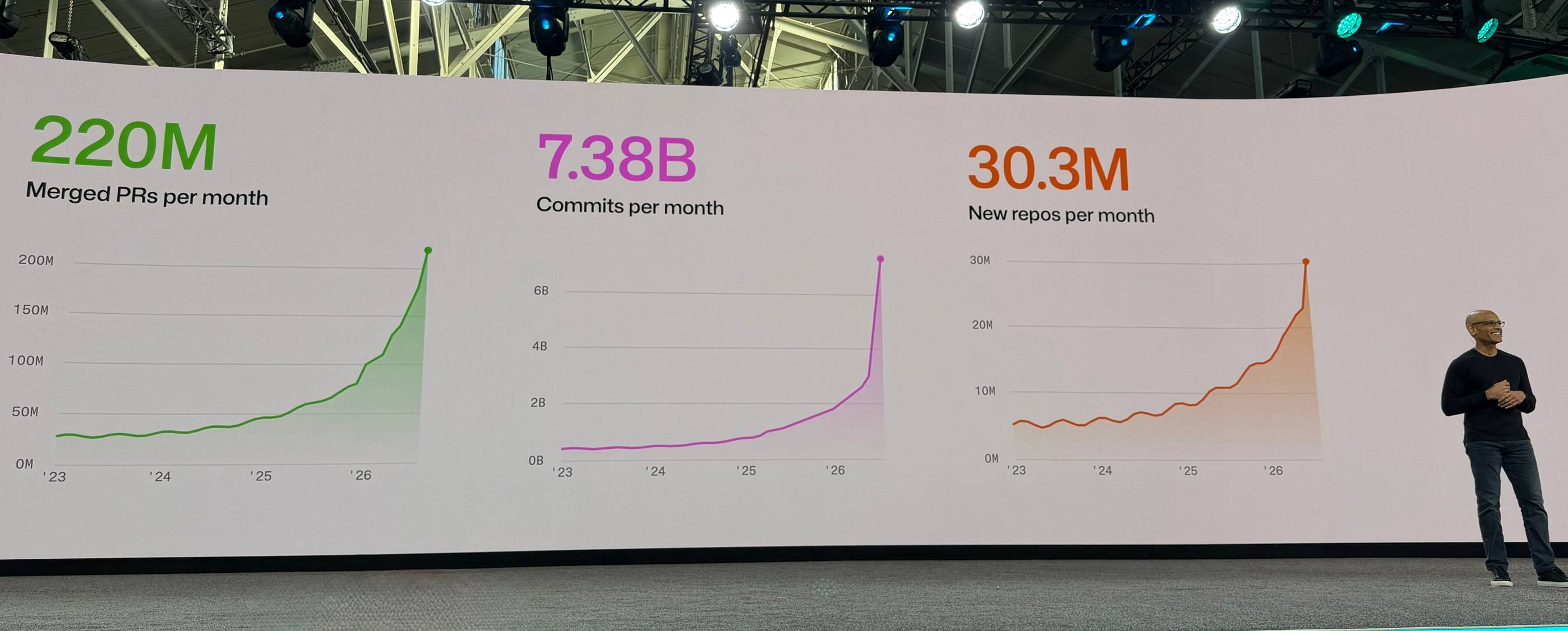
GitHub Octoverse 2026

AI summary At GitHub Universe, executive Jay Parikh presented the company's annual Octoverse report, crediting agentic engineering for a sharp jump in activity. Monthly merged pull requests reached 220 million, roughly triple the level of less than a year earlier, while commits climbed past threefold to 7.38 billion a month, mostly in the second half of 2026. New repositories doubled to 30.3 million monthly. The report also adds breakdowns by industry, classified with a fine-tuned embedding model, and counts projects tied to interoperability or reverse engineering.

Models & Labs The Decoder

OpenAI teases Dots for Europe, but its Berlin DevDay was really about building a platform

AI summary At its DevDay Exchange 2026 event in Berlin, OpenAI said its assistant Dots should reach more European users within weeks, after discussions with regulators; personal Pro accounts in the EEA, Switzerland and the UK still lack access. The company reported that weekly active Codex users in Germany have risen twentyfold since January 2026, without giving absolute figures. OpenAI cited heavy resource needs and low demand for closing Sora in March and for not offering a video-understanding model. It also promoted the Agents API, plugins and reach to 1.2 billion weekly ChatGPT users to draw developers onto its platform.

Models & Labs The Decoder

Claude for Legal now verifies sources automatically, then hands the file to a lawyer

AI summary Anthropic has added pre-built interactive artifacts to Claude for Legal, part of Claude Enterprise, after requests from legal teams since the product's May debut. The tools help with jobs such as checking citations, reviewing contracts against internal rules, following draft legislation and comparing laws between countries, with the model tying each claim to its source before a lawyer checks the output. Over 60 integrations, Bloomberg Law among them, let users link their own databases, while firms including PwC and Harvey offer their own tools on the platform. Anthropic says built-in settings uphold data protection and information barriers between teams.

Free, daily

The HapnGo Briefing, in your inbox

One email a day with the AI stories that matter, why they matter, and one tool worth trying. No spam, one-click unsubscribe.

We only use your address to send the briefing and, if you vote, to count one vote per reader. Privacy.